
Update, 27 August 2026: the final Sydney Plan V1.0 identifies Rouse Hill–Tallawong as a focus for significant housing growth. A subsequent Western Sydney council statement also confirmed that $40 million has been committed to the Tallawong–St Marys business case, which is scheduled for completion in 2026. Neither development forecasts future Tallawong Park & Ride demand or commits to building the Metro link. The 12-week parking patterns and capacity estimate below use data available on 14 August.
On , the NSW Government announced a new multi-storey car park with up to 1,100 additional spaces at Tallawong. Transport for NSW currently lists 975 spaces across P1, P2 and P3, so the full expansion would be a major change.
What is confirmed: the NSW Government announcement published on commits $160 million and proposes up to 1,100 additional Tallawong spaces. The final design, planning status, construction start, opening date, exact capacity, temporary construction impacts and future live-data structure were not specified.
What was announced
The $160 million package announced on covers up to 1,200 additional commuter spaces across Tallawong and Hills Showground. Tallawong accounts for up to 1,100 of them, with up to 100 proposed through an extra level at Hills Showground.
The announcement says the new spaces will join Transport for NSW's Park&Ride system. That matters because eligible commuters can receive up to 18 hours of free parking after completing a public transport journey with the same accepted payment method.
The Sydney Morning Herald's report, published on , also describes the existing overflow into surrounding streets and places the announcement in the context of growing Metro demand.
The government says both car parks regularly reach capacity before 8 am and notes that more than 50,000 homes are planned across the North-West Growth Area over the next 20 years. No construction or opening date was included. The funding is committed, but commuters cannot use any extra spaces yet.
P1, P2 and P3 fill at different times
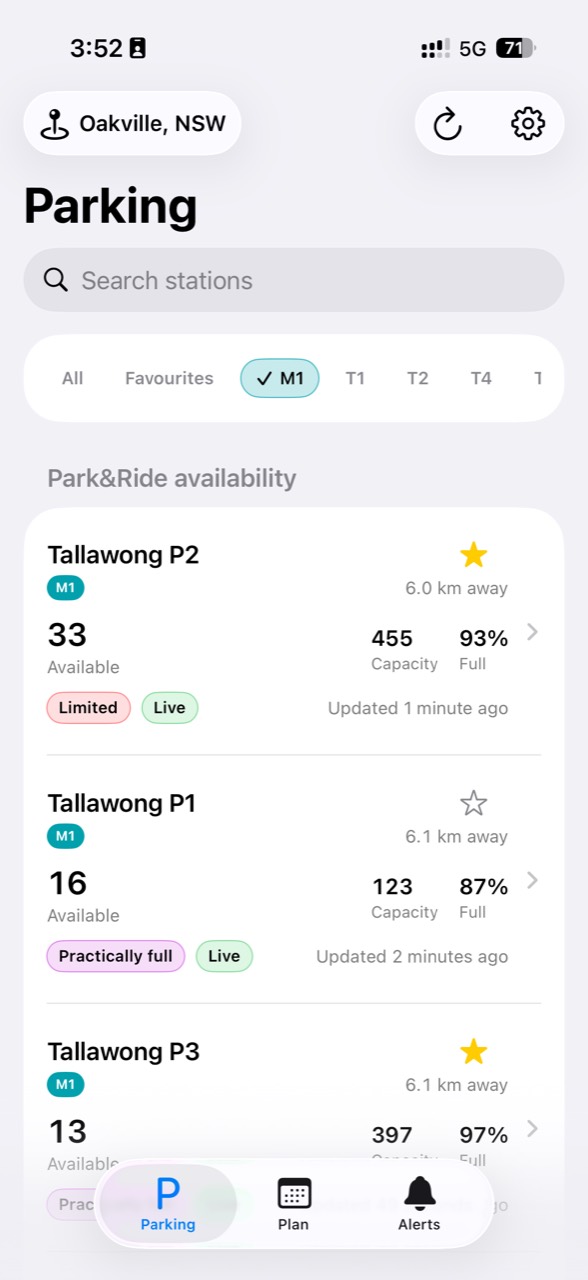
Tallawong's live data is split across three car parks: P1 with 123 listed spaces, P2 with 455 and P3 with 397. Together they total 975, but they do not fill at the same time.
P1 is the smallest and usually becomes tight first. P2 provides the largest single block of existing capacity. P3 often lasts later, particularly on Fridays. ParkRide Planner therefore keeps them separate for live commuter decisions. For the expansion comparison below, however, it is useful to treat all 975 existing spaces as one combined station supply and ask when that supply becomes practically full overall.
Will 1,100 extra spaces be enough?
Delivering the full announced amount while retaining all 975 currently listed spaces would lift Tallawong's official commuter-parking capacity to as many as 2,075 spaces. That is a major expansion and more than double the current official supply.
The demand estimate complicates the picture. The Committee for Sydney's report cites BDO analysis of Transport for NSW data estimating that, on some days, about 2,400 motorists compete for the existing 975 commuter spaces. If a comparable level of demand remained when the expansion opened and those motorists still sought official parking, it would exceed the potential 2,075 official spaces. This is not a count of vehicles parked across surrounding streets, proof that every motorist would use the proposed structure, or a prediction of opening-day demand. It is a useful warning that the expansion may first absorb unmet demand rather than create surplus parking.
Swipe across to compare the capacity figures.
| Measure | Approximate vehicles or spaces | Basis |
|---|---|---|
| Current official listed capacity | 975 | P1, P2 and P3 capacity listed by Transport for NSW |
| Proposed additional capacity | Up to 1,100 | NSW Government announcement |
| Potential total official capacity | Up to 2,075 | 975 plus 1,100, assuming all current spaces remain |
| Estimated commuter demand on some days | About 2,400 | Committee for Sydney report citing BDO analysis of Transport for NSW data |
| Illustrative capacity difference | About 325 | 2,400 minus 2,075; conditional arithmetic, not a predicted future shortage |
Not a demand forecast: official parking capacity is being compared with an estimated number of motorists competing for a space on some days. The report does not make this a count of parked vehicles, or establish that every motorist would use the future structure. Commuter behaviour, feeder-bus use, Metro patronage, population growth, working patterns, construction access and induced demand may all change before the car park opens. The comparison does not prove the expanded car park will be full immediately.
The practical risk is that the new car park may first absorb demand that the current car parks cannot hold. It could still make the commute much easier, but commuters should not assume that 1,100 extra spaces will guarantee parking later in the morning.
What remains unresolved
- the BDO methodology and period behind the demand estimate;
- how many of the estimated motorists would seek the new official structure;
- planning approval, final design and exact final capacity;
- construction commencement, completion and opening dates;
- whether existing capacity will change during construction; and
- when the new car park would appear in Transport for NSW's live data.
The Tallawong catchment is planned to keep growing
The NSW Government finalised Sydney Plan V1.0 on . In its Western Parkland City section, the 20-year plan identifies Rouse Hill–Tallawong as a key station area for significant housing growth. It points to existing transport capacity and available land.
The plan also describes a broader Bradfield-to-Tallawong corridor for major jobs and housing growth, including connections through St Marys and Marsden Park. It does not forecast future Tallawong parking demand or prove that 1,100 spaces will be too few. It does mean today's shortage is not the only issue: the car park also needs to serve a growing surrounding area.
Further update, 29 August 2026: Blacktown City Council resolved on 26 August to approve its revised Marsden Park infrastructure contributions plan, which takes effect on 31 August. IPART's assessment says the plan covers about 2,352 hectares. Its full-development assumptions include about 11,536 additional homes, 33,742 residents and 10,000 jobs across Marsden Park and Marsden Park Industrial Precinct.
Those assumptions existed before this approval. They show the scale of development being planned, not how many residents are still to arrive or how many will drive to Tallawong.
Blacktown City Council's response, also published on 13 August, argues that the growth corridor strengthens the case for better east-west transport and a Tallawong–St Marys connection. A joint Western Sydney council statement published on 14 August says $40 million has been committed to the business case and that it is scheduled for completion in 2026. That is a more concrete planning step, but it remains a business case: neither source establishes an approved or funded construction project.
Future rail access could also change where commuters start their journey. Sydney Metro's planning work includes a St Marys–Tallawong connection via Marsden Park and Schofields. If built, closer Metro access and easier interchanges could lead some commuters to use another station instead of driving to Tallawong. More homes may add parking demand, while better rail access could shift some of it elsewhere. Population growth alone therefore cannot predict Tallawong's long-term parking demand.
What the plan does not tell us: it does not provide a Tallawong-specific Park & Ride demand forecast or a final housing number for the Rouse Hill–Tallawong area. It also does not give a construction or opening date for the new car park. The model below therefore uses recent official parking patterns and does not add a guessed increase from future housing or a reduction from future rail connections.
What the 12-week data through 14 August 2026 showed
ParkRide Planner's main 12-week normal-term patterns, available on , show when P1, P2 and P3 usually reach the app's practically full threshold. These are median results for each weekday, not a claim that every day followed the same timing.
Swipe across to compare all weekdays.
| Weekday | P1 | P2 | P3 | Station pattern |
|---|---|---|---|---|
| Monday | About 5:55 am | About 6:50 am | About 7:25 am | All three typically constrained by about 7:25 am |
| Tuesday | About 6:05 am | About 6:35 am | About 7:00 am | All three typically constrained by about 7:00 am |
| Wednesday | About 6:15 am | About 6:40 am | About 7:05 am | All three typically constrained shortly after 7:00 am |
| Thursday | About 6:20 am | About 6:40 am | About 7:05 am | All three typically constrained shortly after 7:00 am |
| Friday | About 7:00 am | About 7:15 am | About 8:15 am | P3 typically remains available much later |
Data method: these times come from ParkRide Planner's 12-week Plan summaries recorded on 14 August 2026 for P1, P2 and P3. The app uses the median result for each weekday and its practical-full rule for each car park. NSW public holidays and school holidays are excluded. Each car park and weekday has 9 to 11 matching days. Missing readings, sensor uncertainty and repeated source values can shift the result. ParkRide Planner monitors official Transport for NSW car parks, not surrounding street parking.
The median curves recorded on 14 August show zero or near-zero combined availability by 8:00 am from Monday to Thursday. Friday is different: P1 and P2 are typically constrained, while P3 has a median of about 55 spaces at 8:00 am.
This supports the government's broader statement that Tallawong regularly fills before 8 am on the busiest weekdays. The newspaper's reported “before 7 am” description does not fit every car park and weekday. P3's typical practical-full time is after 7 am on Monday, Wednesday and Thursday, and much later on Friday.
What the extra capacity could change
The model below was updated on . It combines the app's main 12-week normal-term median patterns for P1, P2 and P3, minute by minute. The current 975-space station is treated as practically full when about 30 spaces or fewer remain. If capacity reaches 2,075 spaces, the equivalent three-per-cent threshold would be about 63 remaining spaces.
The model shows what the extra capacity could do if the observed arrival pattern continued. It is not a complete demand forecast because the Transport for NSW data cannot count drivers who turn to surrounding streets once the official car parks become tight.
Swipe across to compare all weekdays.
| Weekday | 14 August 12-week typical | Post-expansion estimate | Estimated extra time |
|---|---|---|---|
| Monday | About 7:25 am | About 9:20 am | About 2 hours |
| Tuesday | About 6:55 am | About 8:40 am | About 1 hr 45 min |
| Wednesday | About 7:05 am | About 8:55 am | About 1 hr 50 min |
| Thursday | About 7:05 am | About 8:55 am | About 1 hr 50 min |
| Friday | About 8:10 am | About 11:40 am | About 3 hr 30 min |
Model method: the observed column combines the 12-week median availability patterns for P1, P2 and P3 available on 14 August. Each car park and weekday has 9 to 11 matching days. NSW public holidays and school holidays are excluded. For each weekday, the post-expansion model continues the strongest sustained 30-minute arrival rate seen before the car parks filled, adds the announced 1,100 spaces, then reduces arrivals by 10 per cent every 30 minutes. Results are rounded to the nearest five minutes.
The clearest takeaways
- Tuesday remains the earliest modelled weekday. Even with the added capacity, its stronger pre-capacity demand produces an estimate around 8:40 am.
- Monday, Wednesday and Thursday move to roughly the 9 am range. The model adds about 1 hour 50 minutes to 2 hours before practical full.
- Friday remains markedly later. Its gentler morning peak pushes the station-wide post-expansion estimate towards noon.
- The expansion buys time, not certainty. The model continues observed official-car-park arrival pressure beyond today's capacity ceiling, but it cannot measure unmet demand beyond that capacity.
The government's statement that Tallawong parking regularly reaches capacity before 8 am is broadly consistent with the combined Monday-to-Thursday medians. Friday is the important exception in the 12-week normal-term pattern recorded on 14 August.
Taken together, the current model's clearest Monday-to-Thursday estimate is around 9:00 am. Tuesday is earliest at about 8:40 am, while Monday reaches about 9:20 am. This weekday range is more useful than treating one observed morning as the answer.
What the updated estimate does and does not show
If the full announced capacity is added to the existing 975 listed spaces, Tallawong could have as many as 2,075 commuter spaces. That would be many more spaces, not a small increase.
For commuters, the most immediate benefit should be more time before the station's parking becomes practically full. It may also reduce circling between P1, P2 and P3 and the spill into nearby streets. The real effect will depend on access design, opening arrangements, future demand and whether any existing spaces are changed during construction.
Current capacity-only estimate
Around 9:00 am
The 12-week model spans about 8:40–9:20 am from Monday to Thursday. Friday is later at about 11:40 am.
Observed 20 July compared with the 12-week median
12-week Monday post-expansion scenario
Scenario: start from the 12-week Monday practical-full point at about 7:25 am, carry forward its strongest sustained 30-minute pre-capacity rate of about 630 cars per hour, then reduce that rate by 10 per cent every 30 minutes. Potential capacity is 2,075 spaces; practical full is modelled at 2,012 occupied, leaving about 63 spaces.
This scenario starts with Tallawong's 12-week normal-term Monday median. At about 7:25 am, the existing 975-space station becomes practically full and its sensors can no longer reveal how many additional commuters still want to park. Rather than treating the flattening median as a natural decline in demand, the model carries forward the strongest sustained pre-capacity rate, then tapers it by 10 per cent every half-hour to allow for the morning commute gradually easing. The observed 20 July curve is shown separately to illustrate ordinary day-to-day variation.
Forecast limits: the Monday result of about 9:20 am, and the Monday-to-Thursday range of about 8:40–9:20 am, are estimates rather than measured future results or opening-day predictions. The model assumes all 1,100 spaces are additional, the existing entrances can handle the extra vehicles, and each weekday's strongest sustained arrival rate reflects unmet demand. It then reduces arrivals by 10 per cent every 30 minutes. The estimate does not add the separate demand figure or assume extra demand from future housing. Parking could last longer if arrivals fall away more sharply. It could fill earlier if current overflow shifts into the official car park, new capacity attracts more drivers, entrances cause queues, the catchment grows or demand stays stronger for longer.
Our capacity-only estimate using the 14 August data is therefore roughly 9:00 am from Monday to Thursday, with Friday around 11:40 am. The real fill time could be earlier if unmet demand moves into the official car parks or commuter behaviour changes. Friday's later result is a modelled weekday difference, not a promise of late-morning parking. Once the expansion opens, ParkRide Planner should update these estimates with observed data.
What commuters should take from this
The expansion is funded, but no additional parking is available yet. Based on the 12-week official-car-park patterns recorded on 14 August, a reasonable capacity-only expectation is practical full around 8:40–9:20 am from Monday to Thursday, and around 11:40 am on Friday. The demand estimate and future catchment growth could pull those times earlier if more demand transfers into official car parking. Commuters should not assume the expanded car park will guarantee a space later in the morning.
Until the new car park opens and appears in Transport for NSW's live data, the useful morning habit remains:
- check P1, P2 and P3 separately before leaving;
- treat a very small available count as a warning, not a promise;
- compare today's pace with the matching weekday pattern; and
- keep a nearby alternative in mind if the car park may fill before you arrive.
ParkRide Planner provides live availability, typical fill guidance and Today vs Usual context for Tallawong P1, P2 and P3 within its network of 41 supported NSW Park & Ride car parks.
Compare all three before leaving
Tallawong is not one parking number.
ParkRide Planner keeps P1, P2 and P3 separate so one full car park does not hide space in another. The expansion model looks ahead; the live view helps with today's drive.
Sources and disclosure
This article combines a public project announcement, a BDO analysis cited by Committee for Sydney and aggregated Transport for NSW occupancy observations. ParkRide Planner is independent and is not affiliated with or endorsed by Transport for NSW, Committee for Sydney or the NSW Government.
- NSW Government: More Commuter Parking for Northwest Metro Passengers, published
- Committee for Sydney: State of the City 2026, February 2026. It cites BDO analysis of Transport for NSW data estimating that, on some days, about 2,400 motorists compete for Tallawong's 975 commuter spaces.
- Sydney Morning Herald: New 1100-vehicle car park to be built at busy north-west Sydney Metro station, published
- NSW Government: Twenty-year Sydney Plan finalised, published
- NSW Government: Sydney Plan V1.0, commenced ; see the Western Parkland City priorities and Bradfield-to-Tallawong corridor on pages 74–75.
- Blacktown City Council: Sydney Plan strengthens case for better Western Sydney transport, published
- Penrith City Council: Western Sydney mayors call for transport to catch up with the region's growth, published
- Blacktown City Council: Approval of Contributions Plan No.21 – Marsden Park. Council resolved to approve the revised plan on ; it takes effect on .
- IPART: Review of Blacktown City Council's revised Contributions Plan No.21 – Marsden Park, final report published .
- Transport for NSW Open Data: Car Park API dataset
- How ParkRide Planner's parking guidance works